10 Most Incredible Facts About Saturn Saturn is one of the most beautiful and fascinating planets in our Solar System. Its huge rings make it easy to recognize, even from far away through a telescope. But Saturn is much more than a planet with beautiful rings. It has hundreds of moons, strange storms, icy worlds, powerful winds and some of the most interesting environments discovered by space missions. In this article, let's explore 10 incredible facts about Saturn in simple language. Note: "Most incredible" is an editorial description, not a scientific ranking. 1. Saturn Is the Second-Largest Planet Saturn is the second-largest planet in our Solar System, after Jupiter. Its diameter is about 120,500 kilometres, making Saturn about 9 times wider than Earth . Imagine this: If Earth were about the size of a small...
10 Most Incredible Facts About Saturn

Saturn is one of the most beautiful and fascinating planets in our Solar System. Its huge rings make it easy to recognize, even from far away through a telescope.
But Saturn is much more than a planet with beautiful rings. It has hundreds of moons, strange storms, icy worlds, powerful winds and some of the most interesting environments discovered by space missions.
In this article, let's explore 10 incredible facts about Saturn in simple language.
Note: "Most incredible" is an editorial description, not a scientific ranking.
1. Saturn Is the Second-Largest Planet
Saturn is the second-largest planet in our Solar System, after Jupiter.
Its diameter is about 120,500 kilometres, making Saturn about 9 times wider than Earth.
Imagine this:
If Earth were about the size of a small coin, Saturn would be roughly
the size of a volleyball.
Like Jupiter, Saturn is a gas giant made mostly of hydrogen and helium. It does not have a normal solid surface where a person could stand.
2. Saturn Has the Most Famous Rings in the Solar System
Saturn's rings are probably its most recognizable feature. They are made mostly of water ice, along with rock and dust.
The particles range from tiny grains smaller than sand to pieces that can be as large as mountains.

Saturn's main ring system stretches roughly 282,000 kilometres from the planet, but the main rings are typically only around 10 metres thick.
That's surprising!
Saturn's rings are enormous from side to side but incredibly thin
compared with their overall width.
3. Saturn Has 293 Confirmed Moons
Saturn has a huge family of natural satellites. According to NASA, Saturn has 293 confirmed moons as of August 2026.
These moons are very different from each other. Some are large and nearly spherical, while others are tiny and have strange shapes.
Some important Saturnian moons include:
- Titan – Saturn's largest moon
- Enceladus – famous for water-ice jets
- Mimas – known for its huge Herschel crater
- Iapetus – famous for its dramatic light and dark sides
- Rhea – one of Saturn's larger moons
Saturn's moon system is almost like a collection of completely different worlds orbiting the same planet.
4. Titan Has Rivers, Lakes and Seas — But They Are Not Made of Water
Titan is Saturn's largest moon and one of the strangest worlds in the Solar System.
It has a thick atmosphere and clouds, rain, rivers, lakes and seas. However, because Titan is extremely cold, these liquids are mainly methane and ethane, not water.
Titan is the only known world besides Earth where liquids are known to collect on the surface in this way.
Think about Earth:
Earth has a water cycle where water evaporates, forms clouds, falls as
rain and flows into rivers and oceans. Titan has a similar-looking cycle,
but its liquid is mainly methane and ethane.
Scientists also think Titan has a subsurface ocean of liquid water.
5. Enceladus Shoots Water Into Space
Enceladus is a small icy moon, but it has one of the most exciting features in the Saturn system.
Powerful jets shoot water vapour and icy particles into space from cracks near its south pole.
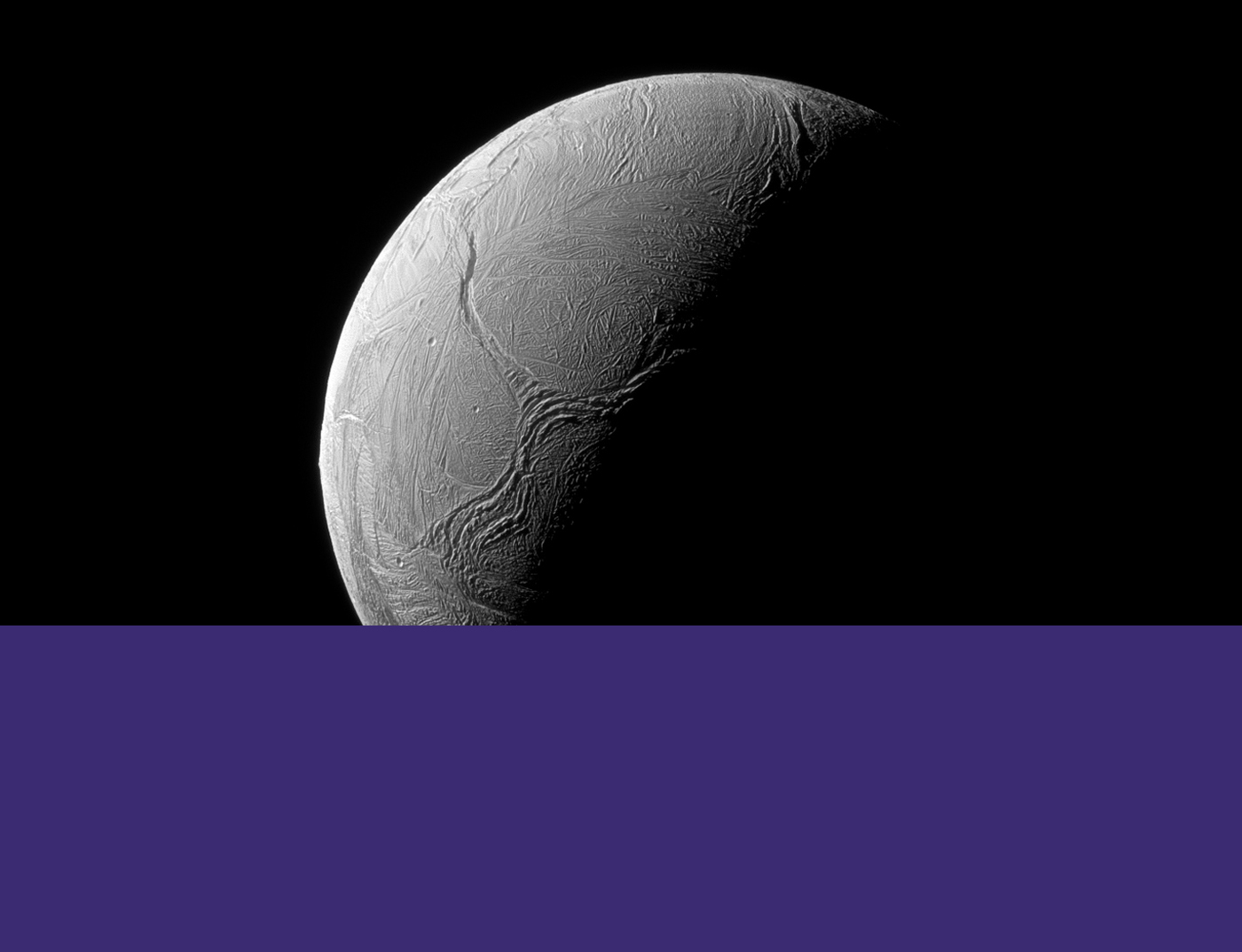
Scientists believe Enceladus has a global underground ocean beneath its icy surface.
The plumes are especially valuable because spacecraft can study material coming from the hidden ocean without having to drill through the ice.
Why is this important?
Enceladus appears to have water, chemical ingredients and an energy source
that could potentially support life as we know it.
6. Saturn Has a Giant Hexagon at Its North Pole
One of Saturn's strangest atmospheric features is a huge six-sided jet stream around its north pole.
Scientists call it the Saturn hexagon.
It is not a solid structure. Instead, it is a giant pattern in Saturn's atmosphere created by powerful winds.
NASA's Cassini spacecraft captured detailed images and movies of this unusual feature.
Imagine drawing a giant six-sided shape in the clouds of a planet
thousands of times larger than a city.
That is roughly how unusual Saturn's polar hexagon is.
7. A Day on Saturn Lasts Only About 10.7 Hours
Saturn rotates extremely quickly. One Saturnian day lasts only about 10.7 Earth hours.
That means Saturn completes one rotation in less than half the time Earth needs.
Its rapid rotation also contributes to Saturn's noticeably flattened shape. The planet bulges around its equator and is compressed somewhat at its poles.
Interesting comparison:
You could have more than two Saturnian days during one ordinary Earth day.
8. Saturn Is Less Dense Than Water
Here is one of the most famous facts about Saturn: its average density is less than the density of water.
In a giant enough imaginary ocean, Saturn would theoretically float.
Important:
This does not mean Saturn could actually be placed in Earth's oceans.
The planet is far too enormous, and no real ocean on Earth could hold it.
The comparison simply helps us understand Saturn's surprisingly low average
density.
Saturn's low average density is related to its composition, which is dominated by hydrogen and helium.
9. Saturn Has Seasons That Last More Than Seven Years
Saturn's axis is tilted by about 26.7 degrees, which is fairly similar to Earth's tilt.
Because of this tilt, Saturn experiences seasons.
But there is a huge difference: Saturn takes about 29.4 Earth years to complete one orbit around the Sun.
As a result, each season lasts more than seven Earth years.
Compare that with Earth:
Earth's seasons change every few months. On Saturn, you would wait years
before one season completely changed into another.
10. Saturn's Rings Are Made of Ice, Rock and Dust
Saturn's rings may look like smooth, solid discs in photographs, but they are actually made of billions or even trillions of individual particles.
Most of the material is water ice, mixed with rocky material and dust.
Scientists think the ring particles may have come from comets, asteroids, or shattered moons that were broken apart by Saturn's powerful gravity.
The rings are also active. Saturn's moons interact with them, and material can move between moons and rings.
NASA's Cassini mission discovered that Enceladus supplies much of the material found in Saturn's faint E ring.
Bonus: Saturn's Moon Mimas Looks Like the Death Star
Mimas is a small Saturnian moon with a gigantic impact crater called Herschel Crater.
The crater is so large compared with the moon that Mimas is often compared with the fictional Death Star from the Star Wars movies.
But Mimas is not just visually interesting. Scientists have also found evidence suggesting that it may contain a subsurface ocean or a water-ice interior with unusual properties.
Why Is Saturn Important to Scientists?
Saturn gives scientists an opportunity to study giant planets, planetary rings and many different types of moons in one system.
The NASA-ESA-ASI Cassini-Huygens mission was especially important. Cassini arrived at Saturn in 2004 and spent more than a decade studying Saturn and its moons before the mission ended in 2017.
The Huygens probe also became the first spacecraft to land on a moon in the outer Solar System when it landed on Titan.
Cassini also discovered the remarkable water plumes of Enceladus and greatly improved our understanding of Titan, Saturn's rings and many other moons.
Quick Saturn Facts
- Position: Sixth planet from the Sun
- Type: Gas giant
- Size: Second-largest planet
- Diameter: About 120,500 km
- Day length: About 10.7 hours
- Year length: About 29.4 Earth years
- Confirmed moons: 293 as of August 2026
- Rings: Yes, spectacular ice-rich ring system
- Largest moon: Titan
- Interesting ocean moon: Enceladus
Conclusion
Saturn is one of the most incredible worlds in our Solar System. Its spectacular rings are only the beginning.
Beneath and around this giant planet are hundreds of moons, strange atmospheric storms, icy oceans, methane lakes and many mysteries that scientists are still trying to understand.
From Titan's methane rivers to Enceladus' water jets, the Saturn system shows us that the Solar System is much more diverse than we might imagine.
Saturn reminds us that even a planet that looks familiar from photographs can hide an extraordinary world of science and discovery.
Comments
Post a Comment